
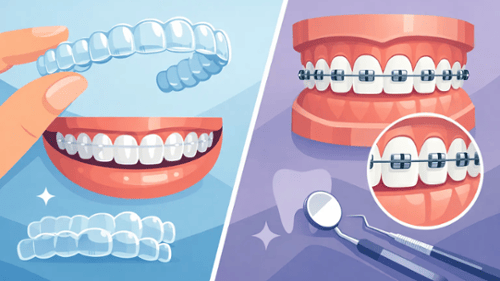
Clear aligners and fixed braces can both straighten teeth and improve the bite. The best choice depends on the movements required, your age, oral health, daily routine and ability to follow treatment instructions.
At BMB Dental Clinic in Mona Vale, we plan orthodontic care around the individual rather than recommending the same appliance for everyone. We welcome adults, teenagers and families from the surrounding northern suburbs.
What is the difference between clear aligners and braces?
Clear aligners are removable, transparent trays that fit closely over the teeth. Each tray applies planned pressure to guide selected teeth gradually into new positions.
Fixed braces use brackets attached to the teeth and a wire that is adjusted during treatment. Because they remain in place, they work continuously and do not depend on the patient remembering to wear them.
Both can achieve excellent results when they are selected appropriately and professionally monitored.
When can clear aligners be a good choice?
Clear aligners are popular with adults and older teenagers who want a less visible treatment.
They can be suitable for crowding, spacing, orthodontic relapse and many bite concerns. Their effectiveness depends on case complexity and consistent wear.
Advantages of clear aligners
- They are discreet
- They can be removed for meals
- Brushing and flossing are generally easier
- There are fewer food restrictions
- The trays have smooth surfaces
- They can fit well around work and social commitments
Responsibilities with clear aligners
Aligners usually need to be worn for around 20 to 22 hours each day. Leaving them out for meals, coffee breaks or social occasions can reduce their effectiveness.
They should be removed for anything other than water and cleaned regularly. Teeth should also be brushed before the aligners are replaced whenever possible.
Some patients need tooth-coloured attachments or elastics. These help achieve more controlled movement but can make treatment slightly more visible.
When can braces be a better choice?
Braces can provide precise and continuous control, particularly when more complex tooth or bite movements are required.
They can also be a practical option for younger patients or anyone who may struggle to wear removable aligners consistently.
Advantages of braces
- They work continuously
- They do not rely on daily wear compliance
- They can manage many complex movements
- They are difficult to lose
- Metal braces are often cost-effective
Responsibilities with braces
Patients need to clean thoroughly around brackets and wires. Plaque can collect near the gumline and increase the risk of gum inflammation or enamel marks.
Hard, sticky and very chewy foods should be avoided because they may break brackets or bend wires.
Regular dental check-ups and professional cleans remain important throughout orthodontic treatment.
Which is more comfortable?
Both treatments create temporary pressure as teeth move.
Aligners usually feel tight for a short time after changing trays. Their smooth surfaces often reduce rubbing against the lips and cheeks.
Braces may irritate the inside of the mouth during the early stages or after adjustments. Orthodontic wax can protect tender areas while the mouth adapts.
Comfort also depends on personal preference. Some patients prefer knowing that braces are always working, while others value being able to remove aligners temporarily.
Which treatment is less visible?
Clear aligners are generally the most discreet option, although attachments may be visible at close range.
Ceramic braces are less noticeable than metal braces and may be considered by patients who want fixed treatment with a more subtle appearance.
Appearance should not be the only deciding factor. The appliance must also be capable of achieving the necessary tooth and bite movements.
Which works faster?
Neither option is automatically faster. Treatment time depends on complexity, biological response, attendance and cooperation.
Aligners can work efficiently when worn as directed. Braces may be more predictable for certain rotations, vertical movements or complex bite corrections.
Be cautious about promises of a guaranteed result by a particular date before a full assessment has been completed.
Which option is better for complex cases?
Braces are often considered when extensive movement, significant bite correction or difficult rotations are required.
Modern aligner systems can manage many advanced cases, sometimes with attachments, elastics or additional refinement trays. However, they are not suitable for every patient.
Some people may benefit from a combined approach or referral to an orthodontic specialist. The recommendation should be based on clinical need rather than appliance popularity.
Clear aligners or braces for teenagers
Aligners can work well for responsible teenagers who can maintain the required wear time and keep track of their trays.
Braces remove the responsibility of remembering to wear an appliance. This may suit busy students involved in school, sport and social activities.
Parents and teenagers should discuss cleaning, food habits, compliance and confidence before choosing.
Clear aligners or braces for adults
Adults often prioritise discretion, comfort at work and the ability to remove an appliance for eating.
Clear aligners may fit these preferences well. Braces can still be the stronger choice when treatment complexity or inconsistent aligner wear is a concern.
Existing crowns, missing teeth, gum recession and restorative plans should also be considered before treatment begins.
How do costs compare?
Costs depend more on treatment complexity than the appliance alone. Limited aligner treatment may cost less than comprehensive treatment, while ceramic braces may cost more than metal braces.
A written plan should explain records, appliance fees, appointments, refinements, emergencies and retainers.
You can learn more about the cost of adult orthodontic treatment and view available payment options.
What dental checks are needed first?
Teeth should not be moved until the mouth is healthy enough for treatment.
Untreated decay, gum disease, dental pain and failing restorations should be addressed first. Your assessment may include photographs, X-rays, digital scans and bite analysis.
This ensures that treatment focuses on both appearance and long-term oral health.
Why are retainers important?
After braces or aligners, teeth naturally tend to move. Retainers help hold them in their corrected positions.
Retainer wear is part of treatment rather than an optional extra. Your dentist will explain the recommended type and schedule.
Long-term retention is essential for protecting the result you have worked to achieve.
How do you make the right choice?
Consider whether you can wear aligners consistently, whether you are comfortable cleaning around braces and how important appliance visibility is to you.
Also consider treatment complexity, food habits, budget and appointment commitments.
The best appliance is not necessarily the newest or least visible. It is the one that can provide a healthy, stable result within your real daily routine.
Book an orthodontic consultation in Mona Vale
A professional assessment is the best way to compare clear aligners and braces for your individual smile.
Book an orthodontic consultation with BMB Dental Clinic in Mona Vale. Our experienced team supports patients from Mona Vale and surrounding northern suburbs with clear advice, personalised planning and ongoing care.